

By: Dr. Shwan Adam Aivas*
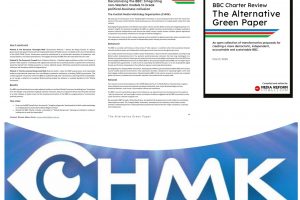
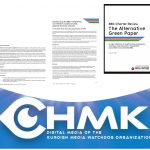
In a landmark moment for Kurdish academic diplomacy and the global movement for media reform, the Kurdish Media Watchdog Organization (CHMK.org) has officially joined the public debate on the future of British public broadcasting. At the formal invitation of the Media Reform Coalition (MRC), I have submitted a transformative proposal for the Alternative Green Paper titled: “From CHMK to MRC: A Kurdish Proposal for the BBC Charter Review.” This submission brings a vital “Global South” perspective to the international stage, advocating for a decolonized BBC model capable of breaking the political and business collusion that increasingly threatens digital governance and media independence.
- Institutional Background & Leadership
The Kurdish Media Watchdog Organization (CHMK.org) is a leading independent body dedicated to media accountability and professional standards that established in 2017. CHMK.org has successfully spearheaded two National Forums** on Media Reform:
- The First Forum (2021): Focused on foundational media ethics and legislative reform.
- The Second Forum (2025): Concentrated on depoliticizing public media and severing party-business ties.
- Executive Summary: The “Integrity Walls” Framework
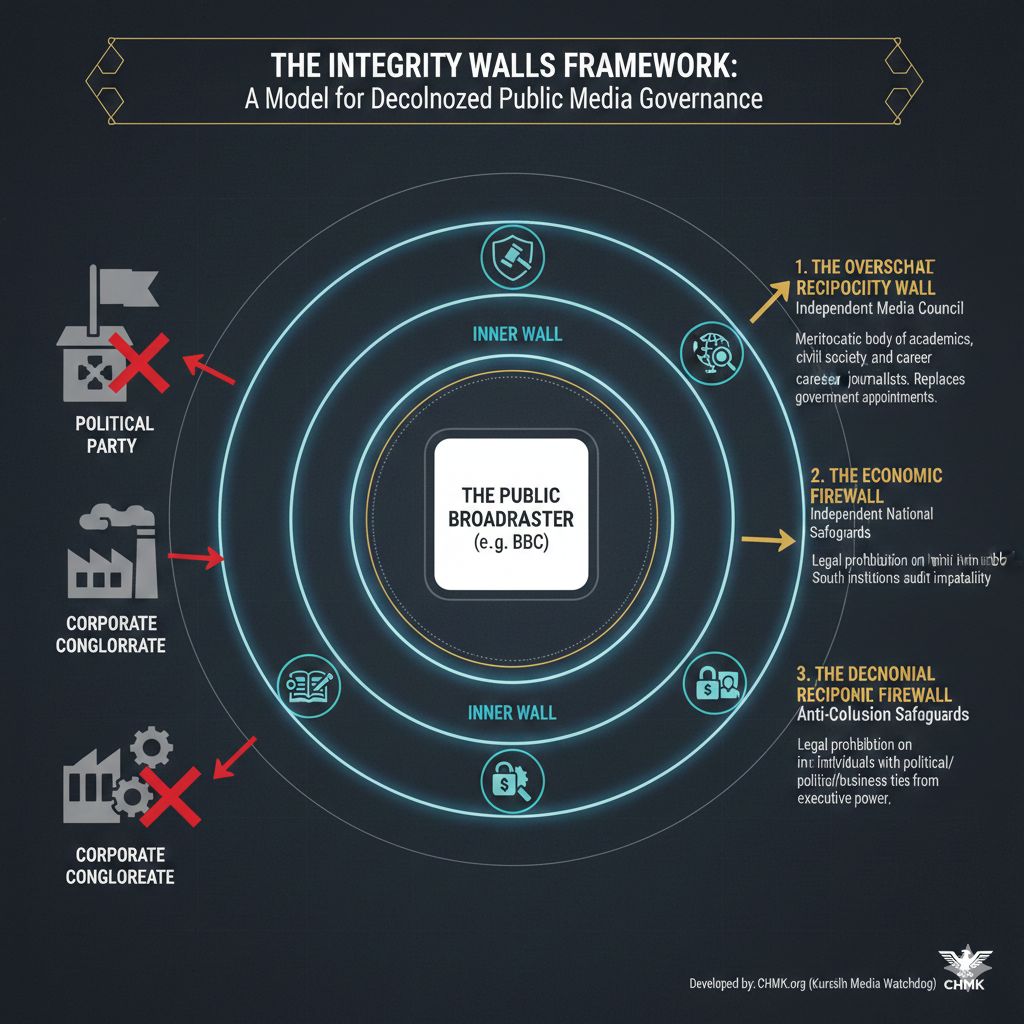
To address the systemic “elite capture” facing modern public broadcasters, CHMK proposes the implementation of Integrity Walls. Unlike traditional Western models that rely on soft norms or “gentlemanly agreements” of impartiality, this framework utilizes hard structural barriers:
- The Oversight Wall: Replacing government-linked appointments with an Independent National Media Council. This body is governed by a meritocratic assembly of academics and civil society, removing the broadcaster from the direct orbit of the executive branch.
- The Economic Firewall: Establishing legal prohibitions that prevent individuals with significant business ties to political parties or government contractors from holding executive or editorial power.
- The De-colonial Reciprocity Wall: Opening the governance structure to international observers from non-Western academic institutions to provide an external audit of impartiality, free from localized political biases, including CHMK.org.
- Proposal: De-colonizing the BBC
This proposal advocates for a structural overhaul of BBC governance by integrating these de-colonial frameworks. We argue that the BBC’s current crisis of legitimacy is a symptom of institutional proximity to power. By adopting safeguards similar to those we have developed to resist collusion in Kurdistan, the BBC can transition from a “state-adjacent” entity to a truly independent global commons.
- Comparative Philosophy: A Model of Mutual Benefit
While the Kurdish and British media landscapes differ historically, they face a universal threat: the merging of political, commercial or corporate, and media interests.
- Innovation from the Margin: Non-Western media systems, out of necessity, have developed more rigorous tools to prevent ruling parties from dominating public discourse.
- Synthesis of Expertise: By sharing these tools, we move toward a global journalism culture that is no longer Western-centric, but a robust synthesis of global expertise.
- Implementation Mechanisms
- Independent National Media Council: Transition BBC oversight to an autonomous body as proposed in the 2025 CHMK National Forum on Media Reform in the Kurdistan Region of Iraq.
- Anti-Collusion “Firewalls”: Legally restrict executive power within the BBC for those with active business-political affiliations.
- Global-South Consultative Seat: Amend the Royal Charter to include international academic witnesses to audit the BBC’s impartiality through a de-colonial lens, such as CHMK.org observers and researchers.
- Call for Strategic Partnership: The Third CHMK National Forum
As we approach the 128th anniversary of Kurdish Journalism Day (April 21-22, 2026), CHMK is organizing the Third National Forum on Media Reform under the title “Media Reform in Post-Conflict Areas: An International Scientific Conference on Kurdistan’s Strategic Policy Roadmap.” We warmly invite the Media Reform Coalition (MRC) to serve as a Strategic Academic Partner. Our goal is to globalize this dialogue, creating a platform where the UK and Kurdish reform movements can co-author a resilient future for public interest journalism.
- Open Consultation Questions
- How can the BBC benefit from the specific “integrity safeguards” developed by media watchdogs in emerging democracies?
- Should the BBC Charter review include a mandate for “Global Reciprocity” with non-Western academic institutions?
- How can the MRC and CHMK collaborate to create a Global Media Reform Model that resists political-business collusion everywhere?
* SHWAN ADAM AIVAS is a leading Kurdish media policy strategist and Chairperson of the Kurdish Media Watchdog (CHMK.org). As General Coordinator of the CHMK National Forum for Media Reform, he spearheads initiatives to modernize ethical standards and safeguard civil liberties in the Kurdistan Region of Iraq (KRI). In January 2026, Dr. Aivas gained international recognition when he was invited by the Chair of the Media Reform Coalition (MRC) to contribute a “Global South” perspective to the UK’s BBC Charter Review. His proposal, “Decolonizing the BBC,” offers a groundbreaking framework for breaking political-business collusion in the digital age. A Kurdish prolific scholar and CEO of the Kanga Educational Foundation (KEF), he remains at the forefront of AI-driven media research and independent journalism.
** Led by Assoc. Prof. Dr. Shwan Adam Aivas, a British Nottingham Trent University alumnus, whose doctoral work redefined Kurdish journalism as a unique non-Western culture, CHMK National Forums serve as a vital bridge. His approach expertly blends Western theory with the “hard-won,” practical safeguards needed to navigate the complex media landscapes of the Global South.