





General information on Calls for Papers in the Journal of Digital Media & Policy:
All articles submitted should be original work and must not be under consideration by other publications. Please review Intellect’s Image and Table specifications here before submitting. The Journal of Digital Media & Policy (formerly known as International Journal of Digital Television) aims to analyse and explain the socio-cultural, political, economic and technological questions surrounding digital media and address the policy issues facing regulators globally. Digitalization, together with the trends towards globalization, deregulation, technological convergence and the rise of the Internet, has enabled media industries, media services and companies to evolve. Online networks are exploring new business models for producing news and entertainment, thereby enhancing consumer choice. Digital media allow people to promote, create, distribute and share experiences with audiences online and create opportunities for innovation through, for example, the establishment of new revenue streams. The journal brings together and shares the work of academics, policy-makers and practitioners, offering lessons from one another’s experience. Content is to be broad and varied, evolving as the focus shifts from switching off analogue TV to the challenge of exploiting digital television’s convergence with the internet and telecommunications.
National case studies and comparative studies are a feature, accumulating the evidence for authoritative global analysis of the economic, political and cultural factors accounting for common principles and national differences.
The journal covers digital television developments all around the world. Although the main focus of policy analysis so far has been on the pioneering countries, we welcome contributions from countries now beginning to consider introducing digital television.
The journal includes book reviews, a ‘feedback and updates’ section with comments or new information arising from articles in previous editions and a feature providing news of government or regulator initiatives, major new service launches and key appointments. Information about major international conferences and events is also welcome.
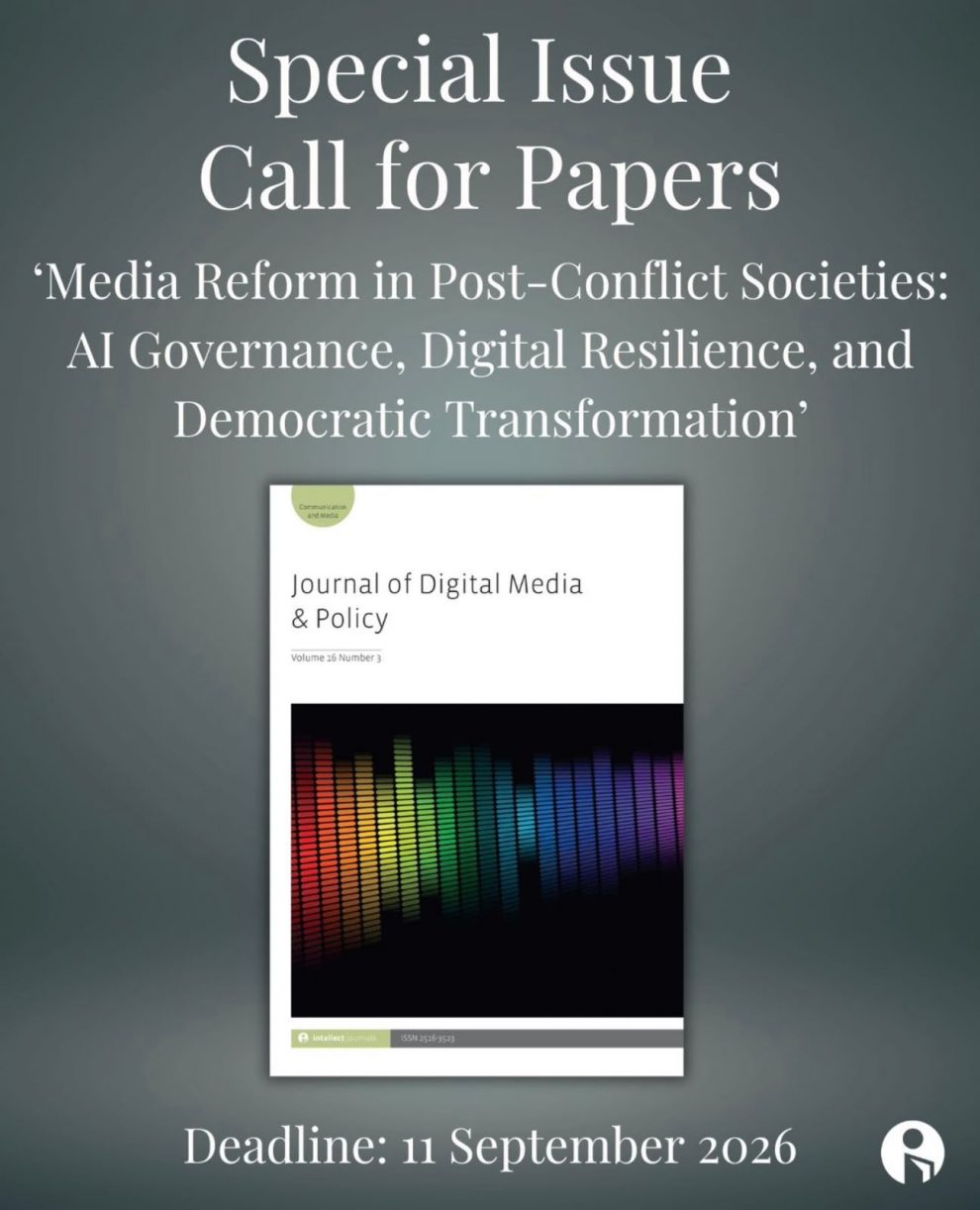
Special Issue Call for Papers
Special Issue: ‘Media Reform in Post-Conflict Societies: AI Governance, Digital Resilience, and Democratic Transformation’
(Volume 19.1 – March 2028)
Guest Editorial Team
Lead Guest Editor: Dr. Shwan Adam Aivas, Associate Professor of Communication, Culture, and Media Studies, Sulaimani Polytechnic University (SPU), Kurdistan Region of Iraq; Founder & Chair, Kurdish Media Watchdog (CHMK); General Coordinator, CHMK National Forum Series.
Co-Guest Editor: Dr. Tom Mills, Senior Lecturer in Sociology and Policy, Aston University (Subject to confirmation).
International Advisory Editor: Dr. Des Freedman, Professor of Media and Communications, Goldsmiths, University of London (Subject to confirmation).
(Final advisory board membership is subject to formal confirmation by the Journal and invited scholars.)
Rationale and Scope
Across post-conflict, transitional and emerging democratic societies, media systems are undergoing profound structural transformations driven by rapid digitalization, political restructuring and the accelerating integration of Artificial Intelligence (AI). These developments present critical opportunities and acute challenges for democratic communication, institutional accountability, media pluralism and public trust.
This Special Issue is directly linked with the academic proceedings and roundtable deliberations of the 3rd CHMK National Forum for Media Reform, hosted at SOAS, University of London, on 8–9 July 2026. While selected presenters and panelists from the London forum are highly encouraged to expand their presentations into full peer-reviewed manuscripts, this Call for Papers is equally open to global scholars, policymakers and practitioners working within the broader scope of transitional media policy.
Using the Kurdistan Region of Iraq (KRI) as an anchor reference case, while actively encouraging comparative, cross-regional scholarship from the Global South and other societies in transition—this issue explores how media reform agendas are evolving in response to technological innovation, institutional governance deficits and shifting paradigms of information production and consumption.
As platformization, algorithmic distribution systems and generative AI increasingly reshape contemporary public spheres, regulators, journalists and civil society actors are confronted with unprecedented questions regarding media governance, information integrity, digital rights and systemic resilience.
This Special Issue aims to synthesize theoretically informed, empirical and policy-relevant research that advances scholarly understanding across three interconnected dimensions of media reform:
1. Regulatory and Institutional Transformation: Examining the development of independent, transparent and accountable regulatory architectures capable of navigating complex digital environments while fiercely safeguarding freedom of expression, democratic participation and human rights.
2. Digital Infrastructure, Security and Information Integrity: Investigating emerging threats associated with cybersecurity, state and non-state disinformation, deepfakes, algorithmic amplification, automated propaganda and computational approaches to content verification.
3. Professional Sustainability and Ethical Media Practice: Exploring viable pathways toward sustainable journalism, media pluralism, newsroom resilience, professional ethical codes and alternative funding models within highly polarized or fragile political economies.
Suggested Themes
We invite original research articles, comparative studies, policy analyses and interdisciplinary contributions addressing themes including, but not limited to:
- The Political Economy of Media Reform in Transitional Societies
- Media Ownership, Market Concentration and Democratic Accountability
- Public Service Media (PSM) and Alternative Governance Models
- Digital Regulation, Platform Governance, and Human Rights
- Artificial Intelligence (AI) and Transnational Media Governance
- Generative AI, Deepfakes and Information Integrity
- Computational Fact-Checking and Automated Verification Systems
- Disinformation, Social Cohesion and Democratic Stability
- Cybersecurity and Societal Resilience in Digital Media Systems
- Media Literacy, Digital Citizenship and Educational Reform
- Hate Speech, Online Harms and Linguistic Integrity
- Journalism Ethics, Professional Standards and the Safety of Journalists
- Media Reform in Post-Conflict and Emerging Democratic Contexts
- Decolonial and Comparative Perspectives from the Global South
Submission Guidelines
Submitted manuscripts must:
- Represent original, baseline, and unpublished research.
- Demonstrate clear theoretical, empirical, and/or policy-relevant contributions.
- Engage deeply with contemporary international debates in media policy and structural reform.
- Adhere strictly to the Journal of Digital Media & Policy author guidelines and style sheet.
- Full manuscripts should typically range between 6,000 and 8,000 words, inclusive of references. Authors are directed to consult the journal’s official submission portal for comprehensive formatting and referencing instructions.
Peer Review Process
All submissions will undergo initial editorial screening by the Guest Editors, followed by a rigorous, double-anonymised peer-review process in strict accordance with the Journal of Digital Media & Policy editorial policies and international scholarly publishing standards.
Indicative Timeline
11 June 2026: Official Launch and International Circulation of the Call for Papers
11 September 2026: Deadline for Abstract Submissions (500 words) and Short Author Biography
11 October 2026: Notification of Abstract Acceptance & Invitation for Full Papers
11 March 2027: Deadline for Full Paper Submission
11 June 2027: Peer Review Feedback Returned to Authors
11 September 2027: Submission of Revised Manuscripts
1 December 2027: Final Editorial Submission to Intellect Publishers
March 2028: Publication of Special Issue (Volume 19.1)
Abstract Submission and Enquiries
Authors are warmly invited to submit abstracts and direct all thematic or structural enquiries to:
Note: Please use the exact subject line: ‘JDMP Special Issue 19.1 Submission’