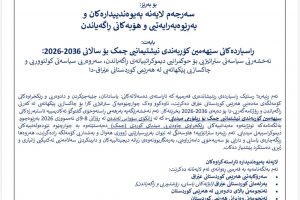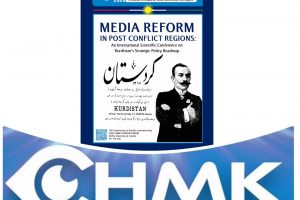


The 3rd CHMK MEDIA REFORM FORUM RECOMMENDATIONS (2026–2036): A 10-Year Strategic Policy Roadmap for Democratic Governance, Cultural Sovereignty, and Structural Reform in Iraqi Kurdistan
Executive Summary & Transmittal Memorandum
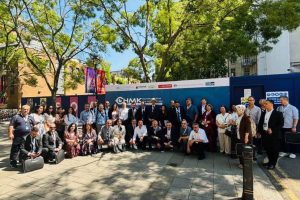
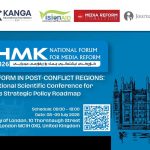
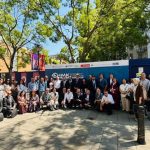
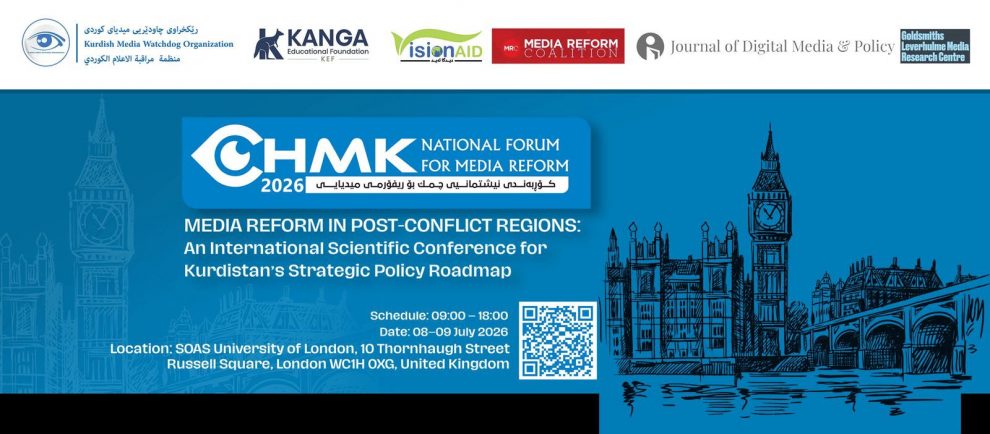
This policy roadmap constitutes the official regulatory proposal submitted to the legislative, executive, and judicial authorities of the Kurdistan Region of Iraq (KRI) to serve as a practical, strategic framework for structural media reform over the decade spanning 2026–2036. Originating directly from the peer-reviewed roundtable deliberations of the 3rd CHMK National Forum for Media Reform, hosted at SOAS University of London on July 8–9, 2026, this document connects years of empirical field research led by the Kurdish Media Watchdog Organization (CHMK) with leading international frameworks for media democracy. Transitioning from a top-down regulatory proposal into an actionable masterplan, this policy paper balances newsroom accountability with community participation. It outlines legal and financial pathways for statutory independence, addresses digital harms, and establishes technical standards for content provenance and algorithmic accountability in the KRI.
Official Transmittal Directives
This document is formally transmitted to:
- The Presidency of the Kurdistan Region of Iraq (KRI)
- The Parliament of the KRI (Legislative, Legal, and Cultural Committees)
- The High Judicial Council of the KRI and its Specialized Tribunals
- The KRG Council of Ministers and Executive Portfolios
- Academic, Public Service, and Cultural Institutions across the KRI
- The Kurdistan Journalists Syndicate (KJS) and Associated Civil Society Organizations
Summit Host & Strategic Co-Organizers
- Host Institution: SOAS University of London (8–9 July 2026)
- Convening Body: Kurdish Media Watchdog Organization (CHMK)
- Development Partners: Kanga Educational Foundation (KEF) & Vision Agency for International Development (VisionAID)
- Academic & Affiliated Frameworks: The UK Media Reform Coalition (MRC), Goldsmiths Leverhulme Media Research Centre (GLMRC), and the Journal of Digital Media & Policy (JDMP).
Authorship & International Review Assembly
Lead Author & General Coordinator
- Shwan Adam Aivas: Associate Professor of Communication, Culture & Media Studies, Media Technique Department, Technical College of Administration, Sulaimani Polytechnic University (SPU); Chair, Kurdish Media Watchdog Organization (CHMK); General Coordinator, CHMK National Forum Series (2021–2026).
Contributing to the International Review Assembly & Advisory Acknowledgements
We extend our deep gratitude to our international advisory colleagues for their expert feedback, peer reviews, and valuable contributions to this policy framework:
- Dr Des Freedman: Professor of Media and Communications, Department of Media, Communications and Cultural Studies, Goldsmiths, University of London; Co-Director, Goldsmiths Leverhulme Media Research Centre (GLMRC).
- Dr Lee Edwards: Professor of Strategic Communications and Public Engagement, Department of Media and Communications, London School of Economics and Political Science (LSE); Chair, UK Media Reform Coalition (MRC).
- Dr Marius Dragomir: Director, Media and Journalism Research Center (MJRC).
- Dr Michael Klontzas: Associate Lecturer, Department of Media and Communications, Goldsmiths, University of London; Managing Editor, Intellect’s Journal of Digital Media & Policy.
- Dr Bakhtiar Amin: Assistant Professor in Artificial Intelligence & Distributed Machine Learning, Department of Computer Science, City St George’s, University of London.
- Dr Dara Salam: Teaching Fellow, Department of Politics and International Studies, SOAS University of London.
Official Portals
🌐 Web: www.chmk.org | forum.chmk.org
📧 Inquiries: [email protected]
I. Modernising Kurdish Media Governance: The Role of CHMK
Table 01 shows that the Kurdish Media Watchdog (CHMK) is a non-governmental civil society organisation dedicated to media ethics, structural reform, and media freedom in the Kurdistan Region of Iraq (KRI). Operating in an environment challenged by political fragmentation, financial opacity, and digital disinformation, CHMK serves as an independent watchdog and media policy institute.
| Table 01: CHMK National Form Rounds between 2021-2026 | ||
| Forum Milestone | Core Focus | Key Outcomes |
| 1st CHMK National Forum (2021) | Digital Ethics & Safety | Frameworks for digital journalism ethics and boundaries for institutional vs. private speech. |
| 2nd CHMK National Forum (2023) | Ownership Transparency | Policy models for a public Ultimate Beneficial Ownership (UBO) ledger to curb shadow funding. |
| 3rd CHMK National Forum (2026) | Omnibus Consolidation | The Omnibus Media Law draft, establishing statutory independence and Anti-SLAPP protections. |
II. Broadening the Scope: Beyond News to a Vibrant Media Commons
While journalism remains critical for political accountability, a public media ecosystem must serve broader democratic, cultural, and social functions. This roadmap expands its strategic scope beyond newsroom governance to encompass the Cultural, Participatory, and Self-Representational Media Ecosystem:
- Community Media & Local Expression: Enacting statutory spectrum reservations for non-profit local radio, television, and digital media to preserve regional arts, linguistic diversity, and community heritage.
- Public Service Media as Tech Forerunners: Transitioning state-affiliated outlets into independent Public Service Media (PSM) capable of co-developing open-access civic tech, localized recommender systems, and public-interest AI tools.
- Participatory Civic Governance: Direct involvement of civil society, regional communities, and audience councils in media programming boards, oversight committees, and public fund allocation.
III. The Integrated Regulatory & Omnibus Consolidation Model
To resolve legal ambiguities and supersede conflicting executive decrees, Parliament must enact the Omnibus General Media Regulation Law.
A. Legislative Migration & Federal Competence Boundaries
- Specific Migration Scope: Civil regulation, broadcast licensing, commercial advertising standards, copyright, and access-to-information laws are fully integrated into the Omnibus Law, explicitly replacing previous administrative decrees.
- Federal vs. Regional Competence: Criminal matters touching on federal communications infrastructure remain under joint regional-federal judicial review. All media disputes within the KRI are strictly redirected away from penal codes and adjudicated under specialised regional civil codes.
B. Legacy Laws Harmonized Under the Omnibus Architecture
- Law No. (04) of 2019; Commercial Advertising Regulation in KRI
- Law No. (11) of 2013; The Right to Access Information in KRI
- Law No. (17) of 2012; Copyright and Neighboring Rights in KRI
- Law No. (06) of 2008; Prohibition of Misuse of Communication Devices (civil media provisions)
- Law No. (35) of 2007; Journalism Regulation in KRI
- Law No. (03) of 2006; Combating Terrorism in KRI (civil media provisions explicitly decoupled)
- Law No. (40) of 2004; First Amendment to Kurdistan Journalists Syndicate Law No. 04 of 1998
- Law No. (13) of 2001; Pension Fund of KRI Journalists
- Law No. (10) of 1993; Press Law of the KRI
C. Six Refined Core Pillars of Democratic Media Reform
The Six Core Pillars of Democratic Media Reform establish a comprehensive, modern blueprint for transforming media governance in the Kurdistan Region of Iraq. By pairing statutory independence and mandatory Ultimate Beneficial Ownership (UBO) transparency with universal protections for press freedom and robust anti-surveillance safeguards, this framework shields journalists while fostering newsroom integrity. Furthermore, it addresses contemporary digital threats by holding major platforms accountable, setting clear AI governance and content provenance standards, and investing in public technology infrastructure to ensure long-term cybersecurity resilience.
Pillar 1: Statutory Independence & Centralized UBO Registry
- National Council of Culture, Communications and Media Affairs (NCCMA): Established as an independent statutory authority. Board members are nominated via a transparent, multi-stakeholder panel (Judiciary, Academia, and Civil Society Watchdogs), confirmed by a two-thirds supermajority in Parliament, and protected by fixed, staggered 5-year terms.
- Ring-Fenced Funding: Financed via spectrum fees and telecom revenues through multi-year statutory allocations that cannot be altered punitively.
- Centralised UBO Registry: Commercial media outlets must disclose beneficial owners holding greater than 1% equity on a public digital ledger. Undisclosed political or proxy funding results in licence revocation.
Pillar 2: Two-Tier Credentialing & Newsroom Integrity
- Un-gated Baseline Rights: Universal protections cover all working journalists, freelancers, and diaspora reporters without requiring state licensing or university degrees, aligning with standard international press freedom protections.
- Voluntary Professional Accreditation: Optional higher accreditation, granting access to official state press pools and union benefits, is managed independently without government oversight.
- Integrity Firewalls: Enforces legal separation between commercial management and newsroom editorial decisions.
Pillar 3: Privacy, Anti-Surveillance & Anti-SLAPP Protections
- Prohibits state or partisan spyware deployment against media professionals and whistleblowers.
- Mandates statutory response timelines for public information requests.
- Establishes fast-track judicial mechanisms to dismiss Strategic Lawsuits Against Public Participation (SLAPP).
Pillar 4: Tackling Digital Harms & Platform Polarization
- Distinguishes between individual citizen speech and institutional/commercial digital operations.
- Holds commercial networks and political organisations liable for coordinated astroturfing, automated bot deployment, and targeted hate speech campaigns.
Pillar 5: Technical AI Governance & Content Provenance
- Establishes digital provenance requirements aligned with global standards such as the Coalition for Content Provenance and Authenticity (C2PA).
- Directs enforcement toward commercial media operations and deliberate synthetic deception rather than individual creators.
Pillar 6: Public Technology Infrastructure & Cybersecurity
- Provides cybersecurity architecture and protection for independent digital outlets against DDoS attacks and domain seizures.
- Funds open-source fact-checking infrastructure and public digital archives.
IV. The Four-Tier Co-Regulation Framework & Institutional Matrix
This roadmap outlines a shared governance structure that distributes responsibilities across the state, statutory regulators, independent media organisations, and civil society. Detailed in Table 02, this matrix defines the distinct statutory mandates and ring-fenced funding mechanisms for each key institutional stakeholder, ensuring coordinated implementation, mutual accountability, and long-term sustainability across the KRI’s media ecosystem.
| Table 02: Framework and Matrix of Institutional Media Reform | ||
| Stakeholders and Bodies | Core Statutory Mandate | Dedicated Funding Mechanism |
| Kurdistan Parliament | Enact the Omnibus Media Law; confirm NCCMA leadership via a 2/3 supermajority. | Statutory Parliamentary Budget |
| National Judiciary | The establishment of specialized courts and the settlement of issues related to the rights and freedoms of expression and the press under special civil laws; Implementation of Targeted Anti-SLAPP Procedures | Ministry of Justice Budget Allocation |
| KRG Council of Ministers | Repeal conflicting executive decrees; coordinate cross-ministry implementation. | Executive Council Operations Budget |
| NCCMA (Statutory Regulator) | Administer UBO Registry, broadcast licensing, community spectrum, and digital oversight. | Ring-fenced Public Media Reform Fund (PMRF) |
| Ministry of Culture & Youth | Transfer licensing duties to NCCMA; reallocate funds toward independent cultural grants. | Reallocated MoCY Administrative Budget |
| Ministry of Higher Education | Consolidate media faculties into a unified College of Culture, Communication & Media Studies. | MoHE Academic & Research Budget |
| Ministry of Education | Embed K-12 Smart Lifelong Literacy across public and private school curricula. | MoE Curriculum & Operational Budget |
| Ministry of Planning | Integrate media reform indicators into national development metrics. | MoP National Strategic Budget |
| Ministry of Finance & Economy | Establish PMRF; manage ring-fenced revenue transfers from telecom fees. | National Spectrum & Revenue Infrastructure |
| Kurdistan Journalists Syndicate | Transition to voluntary accreditation; focus on employment rights and member welfare. | Member Contributions & PMRF Grants |
| CHMK Watchdog & Civil Society | External monitoring; manage automated fact-checking grids; publish compliance audits. | International Grants & PMRF Support |
V. Bottom-Up Civic Capacity: Smart Lifelong Literacy Program
To build bottom-up civic resilience, the Smart Lifelong Literacy Program establishes a progressive educational continuum jointly managed by the Ministry of Education, the Ministry of Higher Education, and CHMK. As detailed in Table 03, producing and consuming media education programmes across every learning stage is vital for cultivating critical thinking, combating digital disinformation, and empowering citizens to navigate an increasingly complex media landscape responsibly:
| Table 03: K-12 Media Literacy Progression Pathway |
| · Primary (Ages 4–11) ► Digital Safety, Sponsored Content & Verification |
| · Secondary (Ages 12–15) ► Source Evaluation, Platform Economics & Bias Analysis |
| · Pre-University (16–18) ► Algorithmic Awareness, Deep-fake Detection & Security |
- Primary Education (Ages 4–11):
- Focuses on basic digital safety, identifying sponsored content, and recognising emotional manipulation online.
- Targets 100% module integration across primary schools by 2028.
- Secondary Education (Ages 12–15):
- Focuses on source verification, platform business models, and active participation in community media.
- Targets on mandatory units in national social studies by 2030.
- Pre-University (Ages 16–18):
- Focuses on algorithmic tracking, counter-disinformation strategies, cybersecurity defence, and deep-fake verification.
- Targets on the Capstone fact-checking project are required for graduation by 2032.
VI. Phased Action Plan & Indicative Fiscal Requirements
Table 04 shows that the phased action plan & indicative fiscal requirements lay out a 10-year roadmap (2026–2036) for implementing democratic media reform across the KRI in three distinct stages:
| Table 04: Implementation Phasing of Media Reform Roadmap (2026–2036) |
| · Phase 01 (2026–2029) ► Statutory Stabilization & Legal Consolidation |
| · Phase 02 (2029–2032) ► System Integration & Institutional Deployment |
| · Phase 03 (2032–2036) ► Structural Realignment & Global Standards |
Phase 01: Statutory Stabilization & Legal Consolidation (2026–2029)
- Key Actions: Enactment of the overarching Omnibus Law, parliamentary confirmation of independent NCCMA leadership, establishment of the Public Media Reform Fund (PMRF), and the initial rollout of foundational K-12 media literacy modules.
- Indicative Fiscal Requirement: The estimated annual budget for this phase is 3.6 billion to 5.1 billion IQD ($2.5M – $3.5M USD). This requirement will be fully and sustainably financed through the Public Media Reform Fund (PMRF), drawing directly from legally ring-fenced telecommunications taxes and spectrum licensing fees.
Phase 02: System Integration & Institutional Deployment (2029–2032)
- Key Actions: Launch of the public, centralised Ultimate Beneficial Ownership (UBO) Registry; transition of the Kurdistan Journalists Syndicate (KJS) to voluntary accreditation; consolidation of university media faculties under the Ministry of Higher Education (MoHE); and deployment of CHMK’s automated fact-checking grid.
- Indicative Fiscal Requirement: The estimated annual budget for this phase is 5.8 billion to 8.0 billion IQD ($4.0M – $5.5M USD). This requirement will be co-financed through reallocated telecommunications revenues, dedicated university academic budgets, and international development grants.
Phase 03: Structural Realignment & Global Standards (2032–2036)
- Key Actions: Full integration of C2PA-aligned technical AI content provenance rules, 100% saturation of K-12 school media literacy programmes, and annual publication of the independently audited KRI Media Sovereignty Compliance Index.
- Indicative Fiscal Requirement: The estimated annual budget for this phase is 4.3 billion to 5.8 billion IQD ($3.0M – $4.0M USD). This requirement will be sustained through long-term statutory PMRF allocations and domestic research grants
VII. Official Ratification & Sign-Off
Adopted as the definitive outcome of the 3rd CHMK National Forum for Media Reform at SOAS University of London (8–9 July 2026), this policy paper serves as the official blueprint for democratic media reform in the Kurdistan Region of Iraq.
Dr. SHWAN ADAM AIVAS
Associate Professor of Communication, Culture and Media Studies at Sulaimani Polytechnic University (SPU)
General Coordinator of the CHMK National Forum for Media Reform
National Organization Chair of Kurdish Media Watchdog (CHMK)
📧 [email protected] | 🌐 www.chmk.org